
by DIANA CAMMARERI17 November 2016
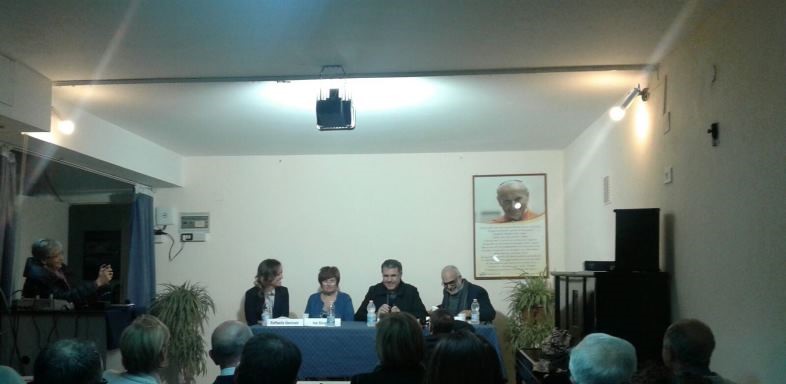
On Monday 14 November at 6.00 p.m., at the Consultorio Familiare “Cana”, the first of a series of meetings was held, entitled “The Mondays of Amoris Laetitia – Dialogue between the wisdom of the Gospel and the human sciences” which aim to explore the contents of Pope Francis's post-synodal apostolic exhortation on the family.
TheAssociazione Oasi Cana Onlus, founded in 1985 on the initiative of Fr A. Santoro OMI, is an association of volunteers who live the charism of St Eugene de Mazenod, founder of the Missionary Oblates of Mary Immaculate, and who care deeply about welcoming and forming the person, the couple and the family. For years Oasi Cana has been engaged in formation activities for children, teenagers, engaged couples, young couples, families and pastoral workers, and it offers the services of a family counselling centre that draws on the collaboration of highly qualified professionals.
The publication of Amoris Laetitia was a challenge for these family workers, and out of their engagement with its contents came the idea of a series of meetings on the themes addressed in the text.
The first event, entitled “Cultural changes: challenges and tasks of the new families” had as its speakers His Excellency Mgr Corrado Lorefice, Prof. Ina Siviglia, lecturer at the Theological Faculty of Sicily, and Prof. Giovanni Salonia OFM Cap., psychotherapist and Director of the Cana counselling centre; the moderator was Dr Raffaella Beninati, psychologist and Deputy Director of the centre.
In the first talk Prof. Siviglia highlighted how Pope Francis places great emphasis on the family, just as Jesus himself directed the newborn Church towards the domestic church: indeed, the Church began not in the temple but within families. In speaking of the family the Pope “started from below, looking at the dreams that are alive in families, while holding firm the ideal of Christ the bridegroom and the Church the bride. The Pope has brought the real closer to the ideal, and that is why, rather than condemning, he looks upon everything with sympathy”. Prof. Siviglia described theapostolic exhortation as “a manifesto of real life”, because the Pope “wanted to reach everyone, indicating the family as the centre of all renewal, preserving tradition within a dynamic of development, in the hope that the Church may know how to speak to the people of our time”.
For Prof. G. Salonia theapostolic exhortation is a revolutionary document, because it speaks of the family in the concreteness and harshness of daily life and can be a useful tool for everyone, even for those who do not have a Christian view of life. “There is an anthropological emergency: people seek happiness, but the categories have changed, we have raised our sights and we are heading for inevitable failures”. The Pope gives an X-ray of the condition of the family, convinced that today it can be reborn, on one condition: “listen first, and then speak with people's own words”.
Lastly, the talk by His Excellency the bishop – or rather by don Corrado, as he prefers to be called – brought out even more clearly some key ideas for a deeper understanding ofAmoris Laetitia. First of all, the Pope's obedience to reality, which must come before doctrine: “History is not an indifferent variable in understanding the Gospel; it is the history of human beings and therefore of the family, not abstract, not ideal, but the one we ourselves have lived in, with everything that entails”. Because without attention to reality “doctrine risks being heartless, beautiful in its ideal form but with no correspondence in life”. The Pope helps us to grasp “the beauty of concrete reality, even in those facets that have little beauty about them”. Mgr Lorefice explains what the happiness people seek really is: it is feeling welcomed “even in that aspect of fragility, of difference, which for the other is a threat to his freedom, to his fulfilment”. It is the episode of the Samaritan woman, welcomed by Jesus with all her frailties, that points the way, for the human heart is made to be loved just as it is.
According to the bishop, it is precisely the Pope's familiarity with the Gospel that allows him to see goodness everywhere in this world full of contradictions, and in doing so he points to a possible pastoral conversion: “the Pope grasps what life is, its weight, its toil, and gives us back the right sense of the rule […] the Pope is not changing the Gospel or doctrine, he is helping to release the power of the Gospel”.
Dwelling on the theme of the Church's updating, he explained how it should be understood: “this good news, the Gospel ever ancient and ever new, which must once again reach the men and women of our time, who struggle to handle the most beautiful thing in human life, which is love”.
This first meeting, attended by a considerable number of people, was certainly an incentive to a deeper reading of Amoris Laetitia, a document that shows us today's family in its various aspects and in a concreteness that is at times harsh, but which, for the Pope, is the place from which society must always set out again.
Source: sicilypresent.it
